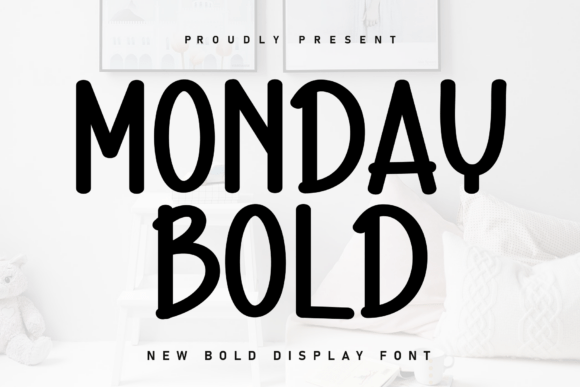
Monday Bold: A Sweet Handwritten Display Font for Crafters
As a maker who designs printable wall art, hand-poured candle labels, and wedding welcome boards, I’m always hunting for fonts that feel personal but still hold up in production. Monday Bold is one of those rare handwritten fonts that doesn’t sacrifice legibility for charm—it’s warm, intentional, and built for real-world craft use.
What makes Monday Bold stand out isn’t just its soft curves or the gentle bounce of its letters along the baseline—it’s how it behaves when printed, cut, or scaled. This is a display font with purpose: every uppercase letter has presence, every lowercase flows like ink on handmade paper, and the spacing feels generous without drifting into looseness. It’s not fussy or overly ornate—just sweet, confident, and quietly expressive.
Where Monday Bold Shines in Physical & Digital Craft Projects
I reach for Monday Bold most often when my project needs personality *and* clarity—especially where customers see it first. Think of a small kraft tag tied to a lavender soap bar: Monday Bold renders beautifully at 14–18pt in print, with enough weight to stay crisp on uncoated stock. Or picture a 3”x5” greeting card—the font holds warmth at smaller sizes while still reading as distinctly handwritten, not digital or stiff.
- Candle & product labels: Its rounded terminals and open counters prevent ink fill-in during thermal printing or label peeling. I’ve used it for soy wax jar labels (with a clean sans serif for ingredients) and seen zero readability complaints from customers.
- Wedding stationery: As a secondary font for names, dates, or “Welcome” headers on acrylic signs or foil-stamped menus, Monday Bold adds intimacy without competing with elegant serif invitations.
- Seasonal SVG designs: For Cricut and Silhouette users, Monday Bold cuts cleanly at 1.25”+ heights—even in layered vinyl. The baseline dance gives movement to holiday banners or Easter egg tags without sacrificing cut accuracy.
- Digital printables: Planner stickers, habit trackers, and boutique-themed Canva templates gain instant cohesion when Monday Bold anchors titles or section headers beside neutral body fonts.
- Product packaging & merch: It works surprisingly well on tote bags and mugs when paired with a subtle shadow or outline—its thickness prevents pixelation at common mockup resolutions (300dpi at 6” width).
Readability Tips You’ll Actually Use
Monday Bold isn’t meant for paragraphs—but it *is* reliable for short phrases, names, and titles up to ~12 words. For sticker sheets or jar labels under 1”, stick to all-caps or title case with tight tracking (–20 to –40 in design apps). Avoid stretching the font; its charm lives in its natural proportions.
When prepping files for cutting machines, convert text to outlines *before* uploading—this preserves the subtle baseline rhythm and prevents unexpected kerning shifts in Silhouette Studio or Cricut Design Space. And if you’re ordering physical proofs, test Monday Bold at your final size on the exact paper or vinyl you’ll use. Its cozy texture reads differently on matte vs. glossy finishes.
Smart Pairings That Elevate Your Brand
Monday Bold thrives in contrast. I pair it with a friendly sans serif (like Montserrat or Poppins) for ingredient lists, care instructions, or pricing—clean + warm = trustworthy. For wedding or boutique branding, I’ll combine it with a delicate serif (such as Playfair Display or Cormorant Garamond) for elegance that doesn’t feel cold.
Avoid pairing it with other expressive scripts unless you’re intentionally creating layered texture (e.g., a watercolor-style quote with Monday Bold as the focal phrase and a thinner script for attribution). Too much motion cancels out impact.
Licensing, Files, and What’s Included
Monday Bold comes as a standard OTF/TTF package—no web fonts or variable weights, which keeps things simple for crafters who need reliability over complexity. It includes basic OpenType features: discretionary ligatures (like “fi” and “fl”), stylistic alternates for select letters (great for avoiding repeat shapes in monogram tags), and multilingual support covering Western European languages—enough for Etsy shops serving US, CA, UK, AU, and EU buyers.
Crucially, the commercial license covers everything I do: selling physical products with Monday Bold on labels or tags, bundling it into Canva templates or SVG bundles, using it in client-branded signage, and including it in digital downloads sold on Etsy or Gumroad. Just remember—you can’t resell the font file itself, and embedding it in editable web templates requires checking the foundry’s extended terms.
Why This Font Fits Real Craft Business Needs
In my shop, fonts are part of my product’s perceived value—not just decoration. Monday Bold signals care, approachability, and handmade authenticity without leaning into cliché. Customers tell me my candle labels “feel like they were written just for them,” and that emotional resonance translates directly to repeat orders and photo tags.
It also supports brand consistency across touchpoints: the same Monday Bold header appears on my printable baby milestone cards, my Instagram story highlights, and the chalkboard-style sign hanging at local markets. That repetition builds recognition—slowly, warmly, authentically.
If you design physical goods, digital printables, or anything meant to be held, gifted, or displayed—Monday Bold earns its place in your font library not because it’s trendy, but because it’s dependable, expressive, and made for makers who understand that type is part of the product, not just the packaging.